What Is Projection Mapping? A Practical Guide to 3D Projection Mapping

What Is Projection Mapping? A Practical Guide to 3D Projection Mapping
Projection mapping turns buildings, stages, products and physical spaces into precisely aligned visual canvases. Here is what it is, howit works, why it can look three-dimensional, and what separates a convincing mapped experience from ordinary projection.
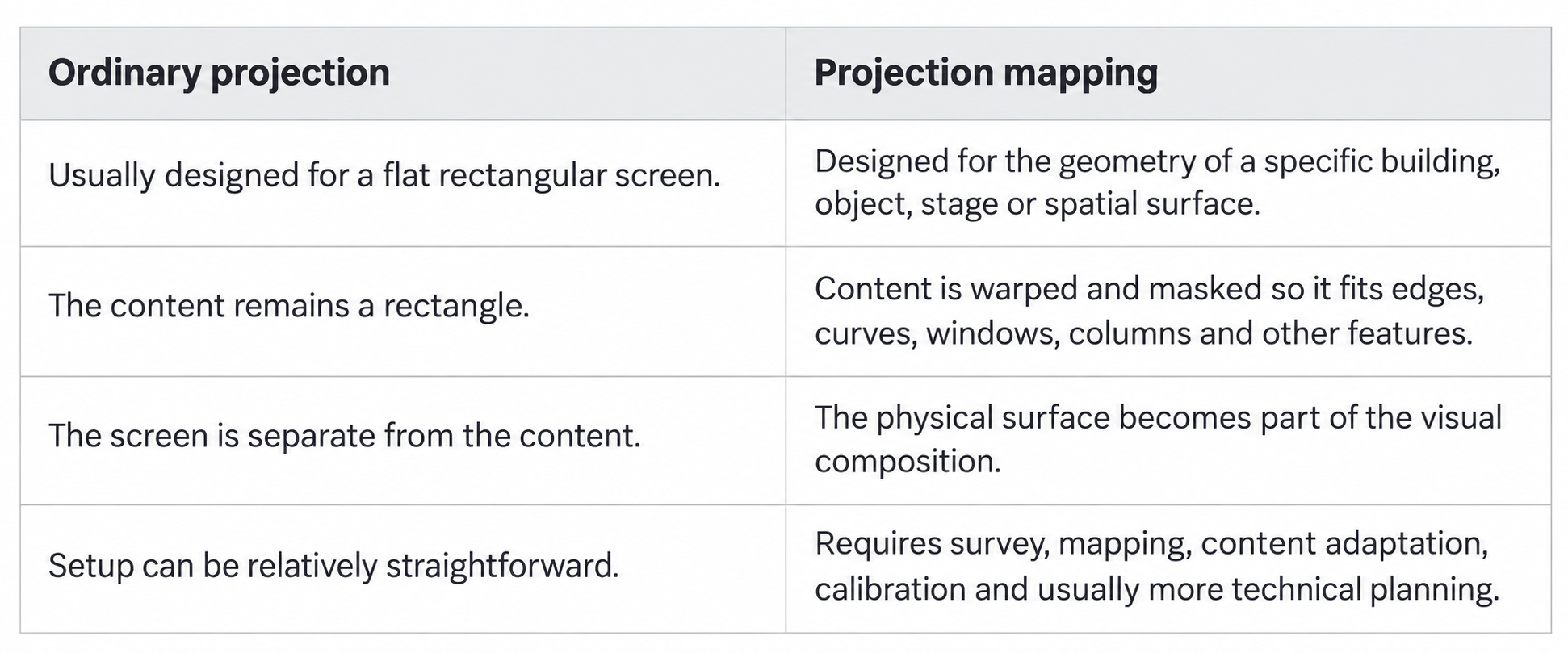
Projection mapping is the process of aligning projected digital content to the exact shape and geometry of a real-world surface.
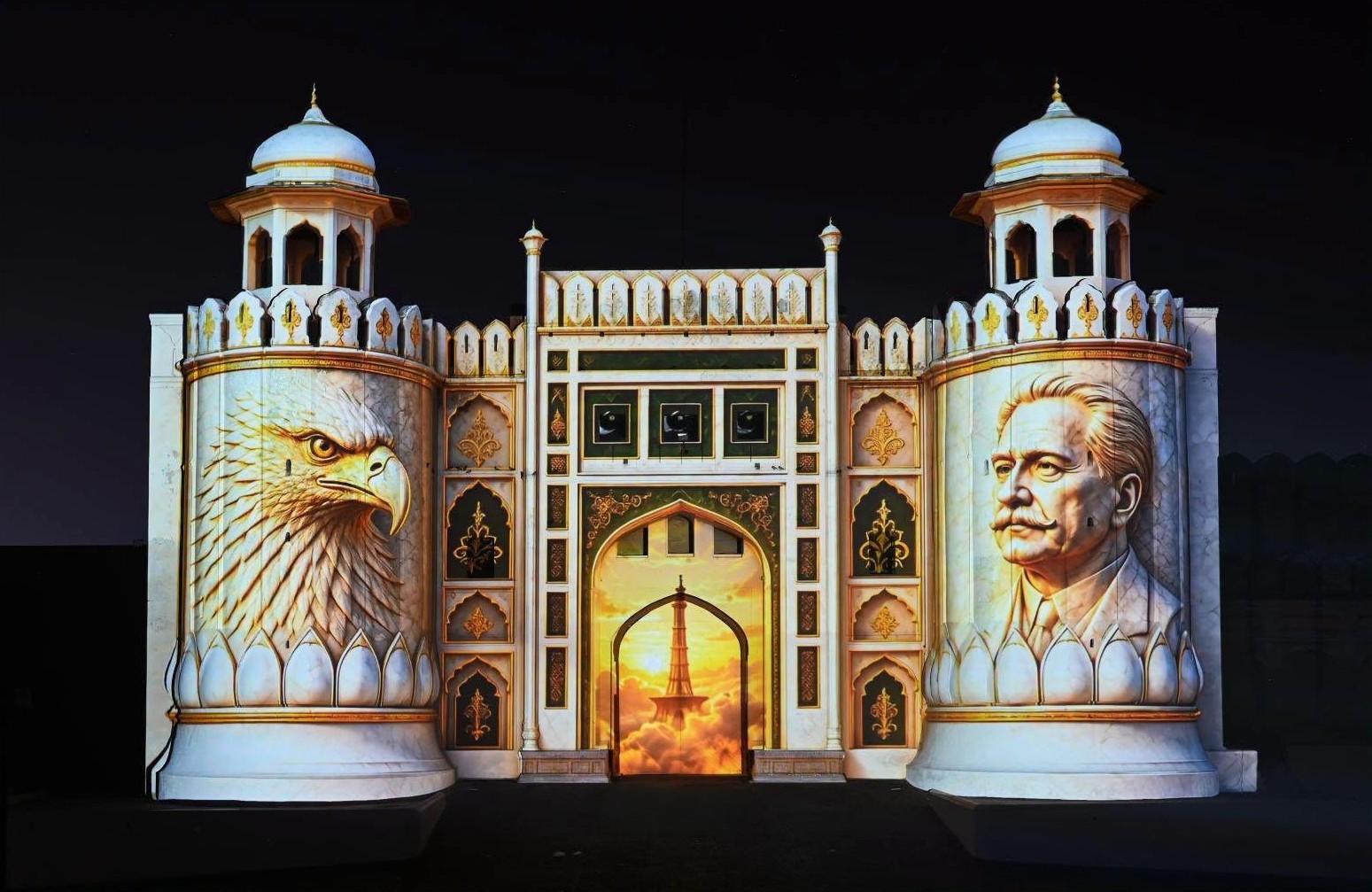
Instead of placing a rectangular video on a flat screen, the image is warped, positioned and calibrated so that it fits a building, stageset, sculpture, product or room. When the content is designed around thesurface itself, architecture can appear to move, open, dissolve, rebuild or transform without the physical object actually changing.
That is why projection mapping is also sometimes calledvideo mapping or spatial projection. The essential idea is the same: the physical surface becomes part of the visual experience.
At Hoola, projection mapping is one of the tools we use toturn architecture, public spaces, events and objects into immersive stories from landmark-scale shows to brand and event experiences across Pakistan.
Projection mapping vs ordinary projection
How does projection mapping work?
Every project is different, but the workflow usually follows six connected stages.
1. Define the experience and surface
The team starts with the objective, audience and physical canvas. A product reveal, a museum installation and a national landmark show require very different creative and technical decisions.
2. Survey and map the surface
Measurements, photographs, architectural drawings,photogrammetry, scanning or a combination of methods are used to understand the geometry. Some projects need a detailed 3D model; simpler surfaces may onlyneed an accurate 2D mapping template.
3. Design the projection system
Projector positions, lenses, throw distances, brightness,coverage, resolution, audience sightlines, power and ambient light are planned around the real site.
4. Create content for that geometry
Motion designers and 3D artists build the visuals around the mapped surface. A window can become a portal, a column can appear to move, or aproduct can seem to assemble itself from light because the animation is designed for those exact features.
5. Align, warp and blend
On site, the projected images are calibrated to the real surface. Where multiple projectors overlap, the images are blended so the audience perceives one continuous canvas.
6. Rehearse and run the show
The media server, visuals, sound, cues and any live elements are tested together under the actual viewing conditions before the audiencearrives.
Internal link: readers who need the detailed operational workflow should be sent to Hoola's 'How to Plan a Building Projection Show'article rather than repeating that article here.
Why does 3D projection mapping look three-dimensional?
Most '3D projection mapping' does not require the audience to wear 3D glasses. The three-dimensional effect is usually an optical illusion created by combining the real depth of the surface with carefully designed perspective, shadows, highlights and motion.
When a projected shadow falls exactly where the eye expectsit to fall behind a real column, that column can appear to move forward. When animation follows the edges of an arch or a tower, the structure can seem toopen or change shape.
The illusion is strongest when the content, viewing positionand architecture are designed together. That precision is why convincing projection mapping feels very different from simply playing an animation on awall.
What equipment is used for projection mapping?
The creative effect may look effortless, but professional projection mapping combines several technical systems:
· High-brightness laser projectors selected for the size, colour and reflectivity of the surface andthe amount of ambient light.
· Projection lenses chosen around throw distance, coverage and available placement positions.
· Media servers and mapping software for playback, warping, masking, synchronisation and edge blending.
· 3D modelling, motion-designand compositing tools used to create the content.
· Audio systems when the experience includes music, narration, sound design or a full Light & SoundShow.
· Power distribution, backuppower, secure projector positions, weather protection and show-control systemsfor live delivery.
· Sensors, cameras or interactive inputs when the visuals need to react to movement, touch, sound orlive data.
There is no universal projector count or lumen number thatsuits every project. Surface size, colour, ambient light, distance, image resolution and the creative treatment all affect the technical design.
Main types of projection mapping
Architectural projection mapping
Buildings, monuments and heritage sites become large-scale canvases for public celebrations, cultural storytelling, tourism and landmark experiences.
Event and stage projection mapping
Stages, scenic structures, walls and ceilings are mapped for conferences, award shows, launches, performances and corporate events.
Product and object projection mapping
Cars, products, sculptures and physical models are transformed through visuals built around their exact shape — especially usefulfor reveals and launches.
Immersive room projection
Multiple walls, floors and sometimes ceilings are treated asone visual environment so the audience is surrounded by the content.
Interactive projection mapping
Sensors, cameras, touch, sound or real-time systems allowthe projected environment to respond to the audience.
What surfaces work best?
Projection mapping can be used on many surfaces, but the quality of the result depends heavily on the physical environment.
Light-coloured, matte surfaces reflect projected light efficiently. Dark materials need more brightness. Glass and highly reflective surfaces can be difficult because they do not hold projected light in the sameway as stone, plaster or scenic material.
Architectural detail can be an advantage. Arches, columns,windows, relief and geometry give designers physical features to animate —provided the content is built around them rather than laid over them.
Ambient light is just as important as surface colour. Street lighting, signage, stage washes and day light all compete with projection, so they must be considered before the technical specification is locked.
Projection mapping vs LED screens, AR andVR
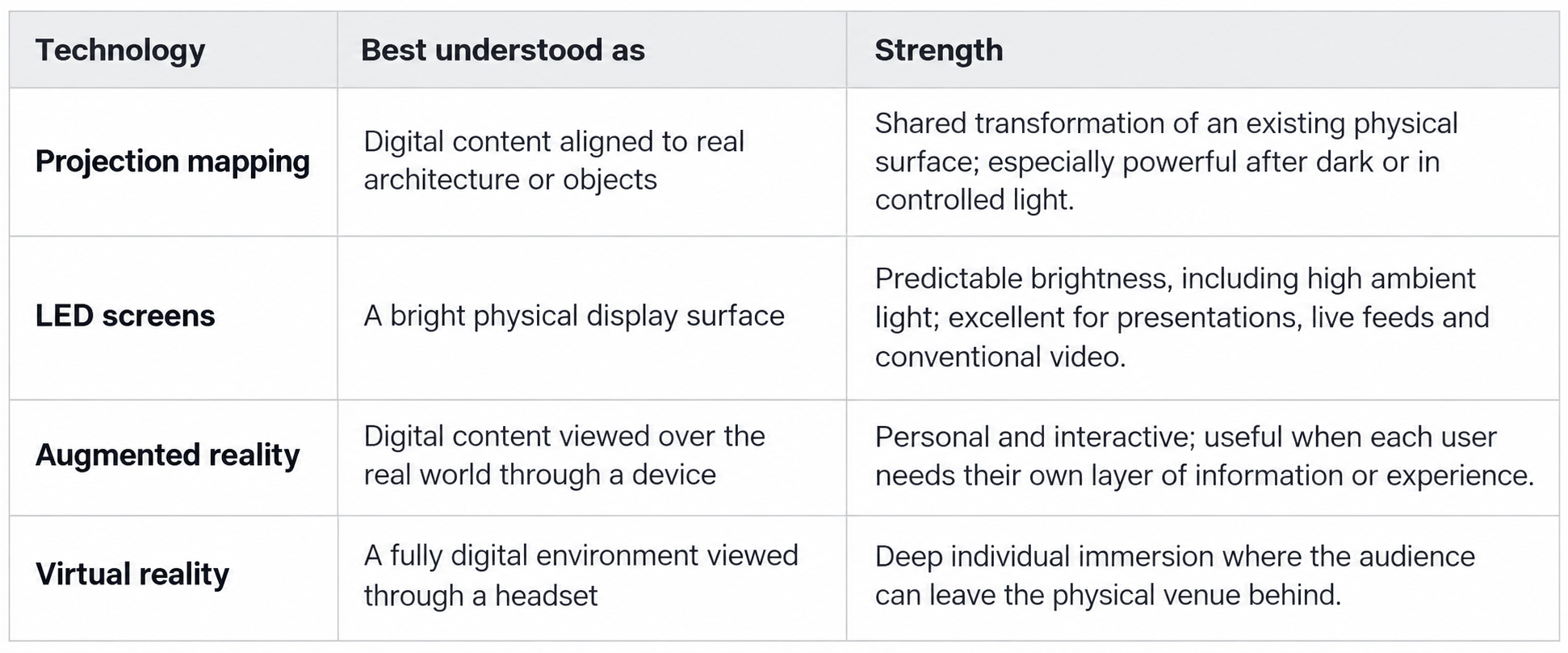
These technologies are not competitors in every brief. Strong immersive experiences often combine them. The correct choice depends onthe audience, environment, message and viewing conditions.
What is projection mapping used for?
· National and cultural celebrations — transforming landmarks into shared public experiences.
· Heritage and tourism — telling the story of forts, palaces, monuments and destinations after dark.
· Product launches and brand activations — turning the product, stage or venue into part of the reveal.
· Corporate events and conferences — creating dynamic stages and branded environments that change withthe agenda.
· Museums and exhibitions — bringing history, science and collections into immersive or interactive environments.
· Immersive installations — surrounding audiences with responsive light, sound and spatial storytelling.
· Real-estate and architectural presentations — mapping models or surfaces to explain places,master plans and future environments.
Projection mapping in Pakistan: Hoola's experience
Hoola's perspective on projection mapping comes from delivering it on real buildings and public sites, not from theory alone.
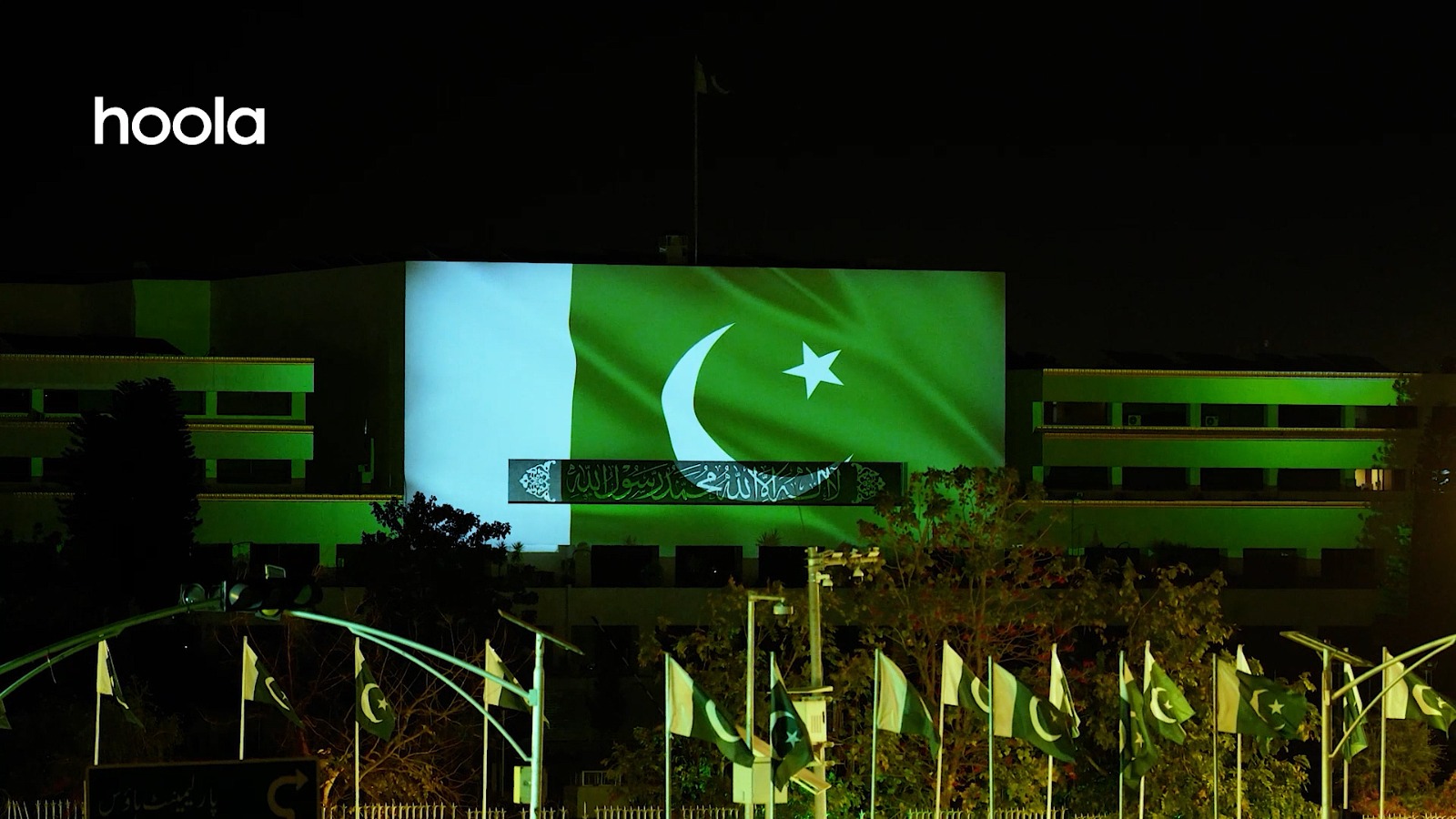
Our work includes 3D projection mapping and Light & Sound experiences at Lahore Fort, Town Hall Lahore, Army Museum Lahore,Pakistan Monument, Parliament House Islamabad, Governor House Punjab, Mazar-e-Quaid, Mohatta Palace, Noor Mahal, Darbar Mahal, Ziarat Residency, Bahawal Club and other sites across Pakistan.
Those projects range from heritage storytelling and national occasions to permanent or recurring immersive experiences. Each has required adifferent combination of creative direction, architectural mapping, projection hardware, content production, sound, approvals, testing and live operations.
For Independence Day 2026 alone, Hoola delivered five landmark experiences in parallel across Lahore and Islamabad — a useful example of how projection mapping becomes both a creative discipline and an operational one at scale.
Internal links: Five Landmarks pillar article; The Promiseof Pakistan; Town Hall Lahore; relevant portfolio pages.
How long does a projection mapping project take?
There is no single production timeline.
A simple indoor mapped element using an existing surface and straight forward content can move relatively quickly. A landmark show with original 3D animation, multiple projectors, sound design, public permissions and several review stages may require many weeks or longer.
The biggest variables are usually content complexity,approvals, site access, technical scale and the number of review cycles. The earlier the mapping team is involved, the more freedom there is to solve these properly.
How much does projection mapping cost?
Cost is driven by the surface and the experience, not by asingle projector rate.
The main variables include the size and colour of thesurface, ambient light, number and class of projectors, lenses, show duration,content complexity, sound, media-server requirements, structural or weather protection, installation time, number of show nights, travel and site permissions.
That is why an accurate quotation normally begins with thevenue, date, surface dimensions or photographs, audience area and the story or outcome the client wants to create.
Is projection mapping safe for heritage buildings?
Projection can be one of the least visually invasive ways to transform heritage architecture because the image itself is created with lightrather than by permanently changing the façade.
That does not mean heritage projects are automatic ally risk-free. Equipment positions, cable routes, access, rigging, crowd movementand any temporary structures still need to be planned with the site custodianor heritage authority.
The right principle is simple: the creative treatment should respect the building, and the technical plan should respect the site.
Frequently asked questions
Is projection mapping the same as 3D projection mapping?
The terms are often used inter changeably. '3D projection mapping' usually emphasises that the content is built around athree-dimensional object or architecture and creates the illusion of depth and transformation.
Can projection mapping work in daylight?
Outdoor projection is usually strongest after dark because sunlight overwhelms projected light. Indoor daytime projection can work where the ambient light is controlled and the technical system is designed for it.
Can any building be projection mapped?
Many can, but not every building is equally suitable.Surface colour, glass, ambient light, projector positions, sightlines and permissions can make a project straight forward, difficult or impractical.
How many projectors are needed?
It depends on the size and geometry of the surface,brightness required, throw distance, resolution and ambient light. A small object may need one; a major façade can require several or many more.
Can projection mapping be interactive?
Yes. Cameras, sensors, touch, sound, live data or otherinputs can be used so the mapped content responds to people or events in realtime.
Does projection mapping damage a building?
The projected image itself does not require permanent visualalteration of the surface. On sensitive sites, however, the entire installation— access, equipment, cabling, temporary structures and crowds must still be managed properly.
Planning a projection mapping project?
Projection mapping sits at the intersection of storytelling,design, architecture and engineering.
The projector is only one part of the system. The quality ofthe final experience depends on how well the surface is understood,
how deliberately the story is designed for it, and how accurately the technical system is executed on site.
Hoola is an immersive visual technology company in Pakistan specialising in large-scale 3D projection mapping, Light & Sound Shows,immersive experiences and creative technology.
If you have a building, stage, product or space in mind,send us the venue, date and what you want the audience to feel. We will help determine what is possible.

Ideas From the Future ofImmersive Tech
Projection Mapping for Corporate Events: 5 Reasons It Works

Planning a projection show?