The Promise of Pakistan: A 3D Light & Sound Show at Lahore Fort.
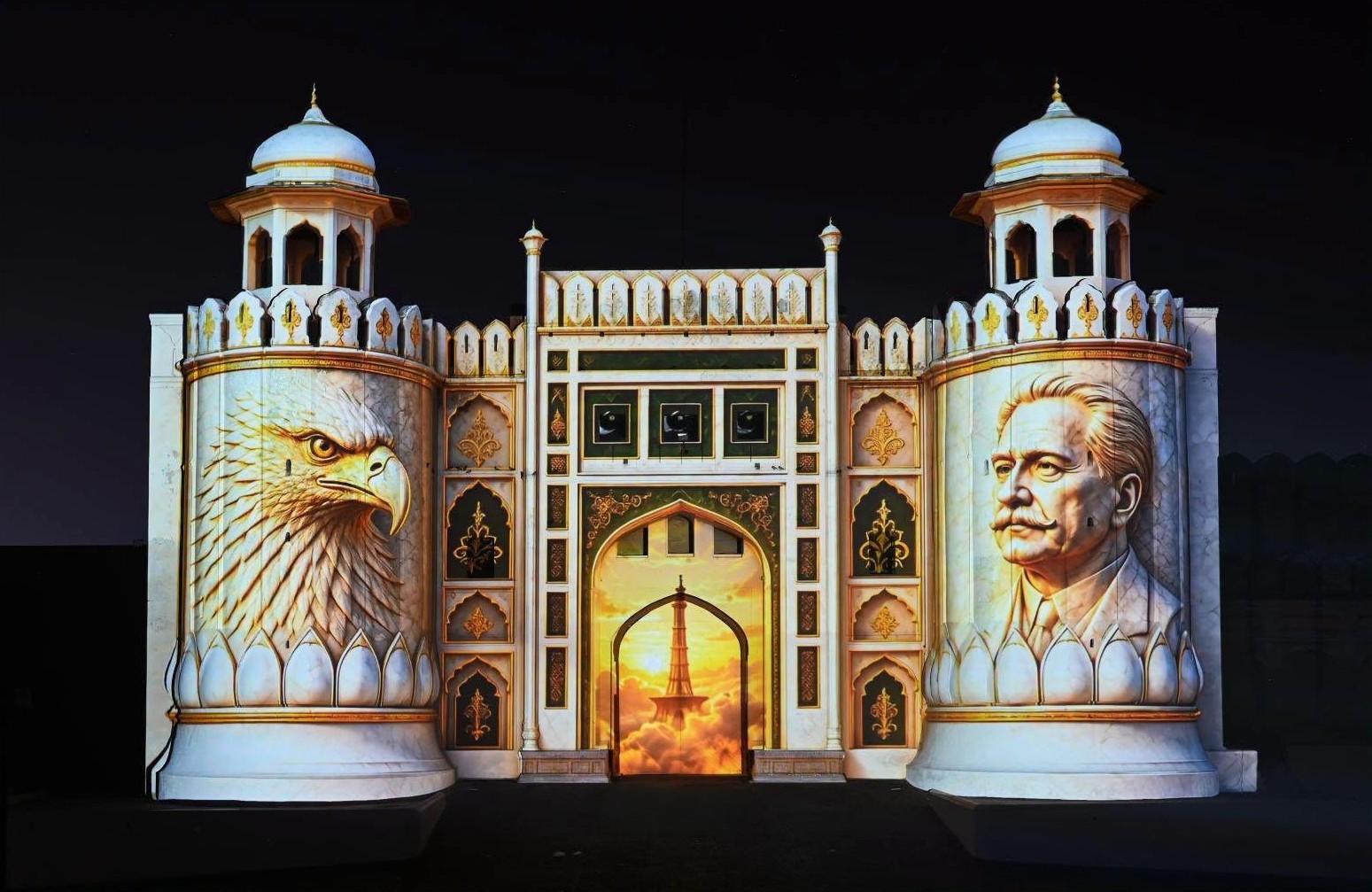
The Promise of Pakistan: A 3D Light & Sound Show at Lahore Fort
At Alamgiri Gate, one of Lahore's most recognisable historic landmarks became the canvas for a story about resilience, hope, and everything Pakistan can still
become. For Pakistan's Independence Day celebrations in 2026, Hoola transformed Alamgiri Gate at Lahore Fort through large-scale 3D projection mapping,
light, and sound.
But The Promise of Pakistan was never intended to be simply a spectacle projected onto a historic building.It began with an idea.Pakistan's story contains
struggle, sacrifice, uncertainty, and extraordinary resilience.But history is only half the story. The other half is possibility what Pakistan can still become. That
became the premise of The Promise of Pakistan: an immersive journey from memory towards possibility, told through architecture, projection, sound, and
light. Across two Independence Day evenings, the experience was free and open to everyone.
Why Alamgiri Gate
Few locations in Lahore carry the visual and cultural weight of Alamgiri Gate. The monumental western entrance to Lahore Fort faces Hazuri Bagh and
Badshahi Mosque and forms one of the city's most recognisable historic views. For projection mapping, the architecture creates both an extra ordinary
opportunity and a technical challenge. Alamgiri Gate is not a flat façade.
Its towers project forward. Arches create depth. Recesses and architectural details divide the surface into multiple planes. Light behaves differently across
every part of it. That means content cannot simply be enlarged and projected onto the building. It has to be designed for the architecture. Towers can appear
to move. Arches can open into new environments.
Stone can seemingly dissolve, shift, or reveal another world behind it. The audience is no longer watching content placed in front of Lahore Fort. he Fort itself
becomes part of the story.
A Story About Where Pakistan Has Been and Where It Can Still Go
The creative direction for The Promise of Pakistan deliberately went beyond a conventional Independence Day montage. The story was built around three
ideas: resilience, hope, and possibility. Pakistan's journey has never been without difficulty.
The country has lived through moments of hardship, uncertainty, and enormous challenge. But it has also repeatedly demonstrated an ability to endure,
rebuild, and move forward. That resilience became the bridge between the past and the future.
The show did not ask audiences only to remember what Pakistan had been through. It asked them to consider what Pakistan can still become. That distinction
shaped the experience from beginning to end. History provided the foundation. Hope provided the destination.
When Architecture Becomes Storytelling
Projection mapping works differently from a conventional screen. A screen contains an image. With architectural projection mapping, the physical structure
becomes part of the visual narrative. For The Promise of Pakistan, Hoola developed the experience around the geometry of Alamgiri Gate. Instead of ignoring
its architecture, the content responded to it.
Lines followed structural features. Depth created illusion. Towers, arches, and openings became part of the animation. Sections of the façade could seemingly
shift, open, and transform as the story progressed. Projection, sound, and architecture worked together so that the audience was not simply being shown
imagery. They were experiencing the landmark itself differently.
That is the difference between projecting onto architecture and creating an experience with it.
Building a 3D Projection Mapping Experience at Lahore Fort
What the audience ultimately sees is the finished illusion. Behind it is a considerably more complex process. Large-scale 3D projection mapping at Lahore Fort
requires creative production and technical execution to work as a single system.
The architecture first has to be understood and mapped. Content must then be designed around its proportions and geometry. Projection positions and throw
distances have to work within the physical environment around the Fort. Brightness and contrast have to account for ambient light.
Play back systems have to deliver high-resolution content reliably. Multiple projected images must align accurately enough that the audience perceives one
continuous visual environment rather than separate beams of light. And finally, everything has to be calibrated on the real architecture.
A digital model can tell a creative team where an arch is supposed to be. Final alignment determines where that arch actually appears once millions of pixels
meet centuries-old stone. That intersection of creative technology, story telling, and technical engineering is where true architectural projection mapping
happens.
Made for Lahore
The experience was created as part of Punjab's Independence Day celebrations and was free and open to the public. That mattered. Families came. Young
people gathered. Visitors arrived throughout the evening. Large crowds filled the viewing area in front of Alamgiri Gate to experience the show together.
And once the experience moved online, its audience became considerably larger. Images and videos circulated across social media, carrying the
transformation of Lahore Fort far beyond the people physically standing in front of it. Public projection mapping has that unusual ability.
The physical experience is intensely local one building, one place, one audience standing together. But the imagery it produces can travel almost
immediately. For those evenings, one of Lahore's most familiar historic views became something people had never seen before.
A Historic Landmark Telling a Forward-Looking Story
Heritage projects can easily become exercises in nostalgia. The Promise of Pakistan deliberately avoided that. Lahore Fort already carries centuries of history.
There was no need to manufacture significance for the setting. Instead, Hoola used that history as the starting point for a story facing forward.
A landmark that had witnessed generations of change became the medium for a message about what another generation might still build. That contrast was
central to the experience. Centuries of history behind it. Possibility ahead of it.
One Landmark Within a Five-Site National Operation
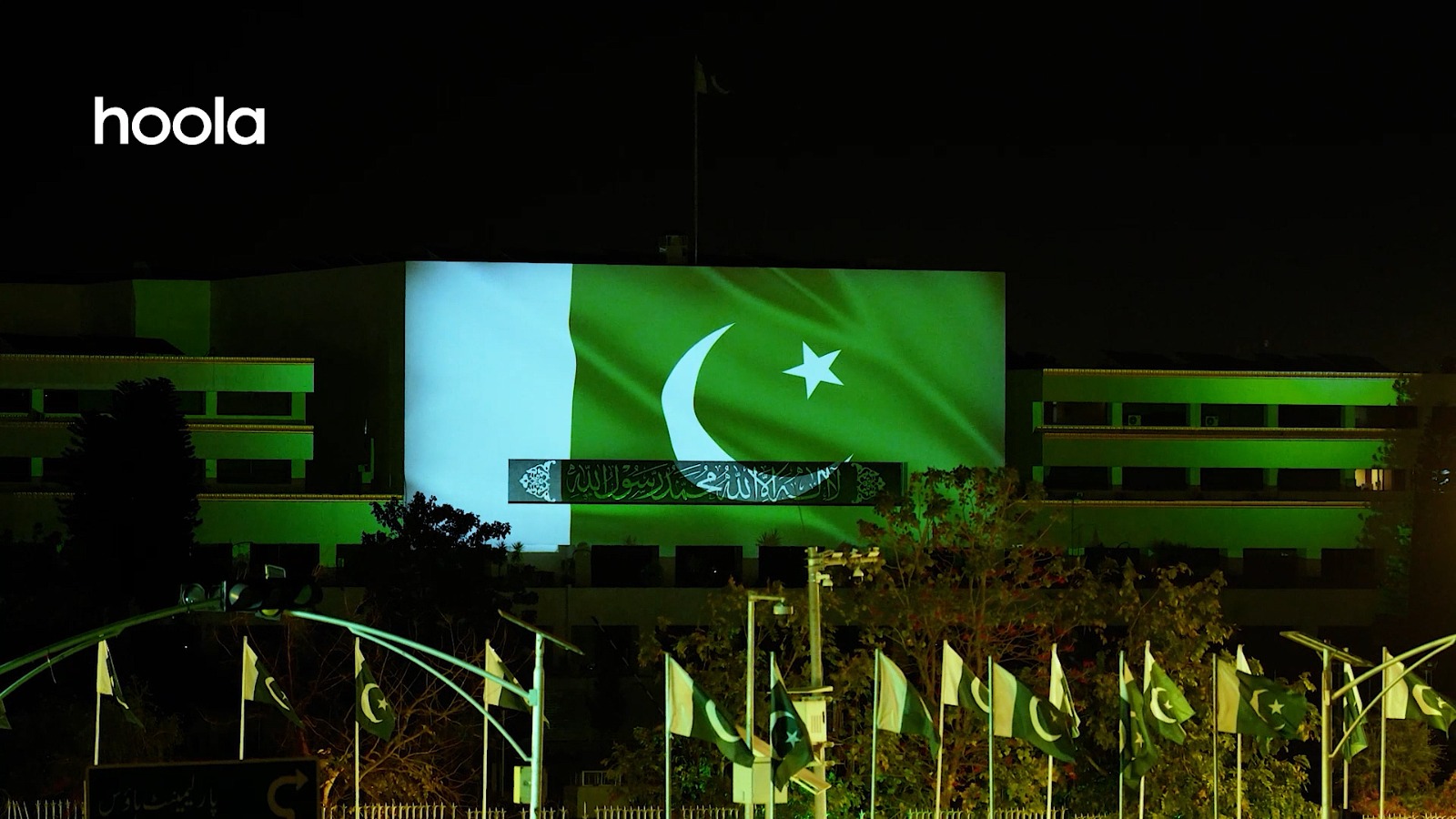
The Lahore Fort experience was also part of a much larger Independence Day production. For the same national celebration, Hoola delivered immersive visual
experiences across five major landmarks in Lahore and Islamabad in parallel:
- Lahore Fort Alamgiri Gate
- Town Hall Lahore
- Army Museum Lahore
- Parliament House Islamabad
- Pakistan Monument Islamabad
Every location required its own architectural mapping, technical planning, and site-specific visual treatment. That wider operation demonstrated Hoola's ability
to deliver large-scale projection mapping across multiple landmark sites simultaneously.
But The Promise of Pakistan demonstrated something equally important: depth. This was not simply one of five surfaces receiving content.
It was a complete creative experience conceived around one building, one audience, and one story. The five-landmark programme demonstrated scale. The
Promise of Pakistan demonstrated storytelling.
Projection Mapping and Heritage Architecture
Historic architecture has something a purpose-built event stage cannot recreate: memory. People already know the building. They recognise its silhouette.
They understand that it existed before the experience began and will remain long after it ends.
That familiarity makes its transformation more powerful. When an unfamiliar stage appears to change shape, the effect can be impressive.
When Alamgiri Gate appears to transform, the audience understands what is being transformed. Projection mapping uses that existing relationship between
people and place. The landmark brings the history. Technology gives it a temporary new language.
Transforming a Landmark Without Permanently Changing It
Projection mapping is particularly suited to historic, civic, and culturally significant architecture because the transformation itself is temporary. Digital content
is precisely aligned with the building while projection equipment and technical infrastructure remain separate from the façade.
That allows architecture to appear to move, open, transform, or reveal entirely new environments without requiring permanent visual alteration to the
structure. For a heritage landmark such as Lahore Fort, that quality matters. The experience can feel monumental. The intervention does not need to be
permanent.
Watch The Promise of Pakistan Full Show
The complete 3D Light & Sound Show at Lahore Fort can be experienced below.
Why Immersive Experiences Like This Matter
Technology is not ultimately the reason an experience stays with an audience. Technology makes the experience possible. What matters is what it enables
people to feel. For The Promise of Pakistan, 3D projection mapping allowed architecture associated with centuries of history to carry a message directed
firmly towards the future.That contrast was the point.
A gate built centuries ago became the canvas for a question about what comes next. A national story did not have to conclude in nostalgia. It could end in
possibility.
A Promise, Brought to Light
For two Independence Day evenings, Alamgiri Gate became more than the entrance to Lahore Fort. It became a storyteller. Its architecture carried a journey
through struggle, resilience, hope, and possibility. The experience belonged not to an invited audience behind closed doors, but to the people who came to
see it. Then the projectors switched off. The Fort remained exactly where it had always been.
The experience stayed with the audience. That was The Promise of Pakistan.
A Promise, Brought to Light.


Ideas From the Future ofImmersive Tech
Projection Mapping for Corporate Events: 5 Reasons It Works

Planning a projection show?