Projection Mapping for Corporate Events: 5 Reasons It Works

Projection Mapping for Corporate Events: 5 Reasons It Works
When the venue, stage or product itself becomes part of thestory, the audience is no longer looking at another screen. That is where projection mapping earns its place in a corporate event.
Corporate audiences have seen screens, branded backdrops and presentation decks countless times. Projection mapping offers something different: it allows the physical environment itself to carry the message.
A stage can change character between sessions. A product can become the centre of its own reveal. A wall, ceiling, scenic structure or building can move from brand story to keynote environment to celebration without physically rebuilding the entire space.
That does not make projection mapping the right answer for every event. It works best when the surface, lighting, audience and story are considered together from the beginning.
For brands and event teams planning a launch, conference,gala or immersive activation, these are the five reasons it can be worth considering.
What is projection mapping in a corporate event?
Projection mapping uses calibrated digital projection to fit visuals precisely onto a real surface such as a stage set, wall, ceiling,product, sculpture or building rather than displaying a rectangular video ona conventional screen.
Because the content is designed around the geometry of that surface, the environment can appear to move, open, rebuild, change material or reveal new spaces. In a corporate setting, that lets the brand story exist inthe room rather than only on a screen.
Internal link: 'What Is Projection Mapping? A PracticalGuide to 3D Projection Mapping'.
1. It turns the venue into part of the brand experience
Most corporate venues were not designed for your brand. Aballroom, convention hall or temporary stage belongs to the event for a few hours and then returns to something else.
Projection mapping can give that borrowed space a visual identity of its own without relying only on printed panels or a single rectangular screen.
Walls, columns, stage geometry, ceilings or scenic structures can carry the visual language of the event. The audience enters an environment that feels designed for the occasion rather than simply branded around the edges.
The key is restraint. Logos repeated across every surface are still just logos. The stronger use of mapping is to turn brand colours,motion, product language and narrative into an environment people can feel asthey enter the room.
2. It creates product reveals that feel designed, not staged
Product launches are one of the clearest uses of projection mapping because the product itself or the space around it can become partof the reveal.
An automotive launch can use mapped light to trace the form of a vehicle before the physical reveal. A technology product can appear to assemble from its internal components. A new development can emerge from an architectural model. A brand identity can unfold across the stage instead of arriving as the next slide in a deck.
The strength is not simply spectacle. Projection lets the reveal communicate something about the product before the audience sees it clearly: speed, precision, engineering, craft, scale, transformation or whatever idea the launch is built around.
When the story and product are designed together, the reveal becomes the message rather than decoration around it.
3. One space can change with the agenda
A corporate event may need several visual personalities inthe same room: leadership address, keynote, panel discussion, product segment,awards, dinner and celebration.
Projection mapping allows one mapped environment to carry different looks without physically rebuilding the stage between every section.
A structured keynote environment can become a product world,then an awards back drop, then a more atmospheric closing sequence using the same mapped surfaces and technical system.
This can reduce dependence on repeated scenic changes and single-use printed graphics, but it should not be sold as automatically cheaper. The value depends on how much custom content, projection hardware and physical set work the event actually needs.
4. It creates a shared moment people want to capture
Corporate events compete for attention in the room and forrelevance after the event is over.
A strong mapped sequence gives the audience a shared visual moment the kind of moment that makes people look up, stop talking and reach for their phones because something in the physical space has changed unexpectedly.
That can produce useful event content: guest videos, social posts, recap films, media coverage and shorter edits that keep the launch or campaign moving after show night.
The important point is that share ability should be designed,not assumed. Clear sightlines, a strong hero moment, good capture positions and a sequence that reads well on camera all need to be part of the plan.
5. It can connect projection, sound, lighting, live performance and interactivity
Projection mapping becomes much more powerful when it is treated as one part of the experience rather than a stand alone visual effect.
Mapped content can be synchronised with music, sound design,lighting cues, live speakers, performers, motion sensors, cameras, data or interactive systems.
For a technology or AI launch, the visuals can respond to audience input or live information. For a gala, the room can transition withthe programme. For a product reveal, lighting and sound can build towards the same moment as the projection rather than competing with it.
That combination of creative direction and technical integration is where immersive event design moves beyond 'AV' and becomes an experience.
Where projection mapping works best in corporate events
Product and automotive launches
Use the product, stage or surrounding architecture as the canvas for a reveal and product story.
Brand and identity launches
Introduce a new brand, campaign or strategic direction through an environment that changes with the narrative.
Conferences and leadership events
Build a dynamic stage that can change between key notes,panels, data, films and transitions.
Award nights and gala dinners
Use mapped environments to create atmosphere, ceremony and distinctive moments for categories or winners.
Real-estate and development launches
Map physical models, scenic architecture or large surfaces to explain place, scale, phases and future vision.
Technology and AI experiences
Combine projection with sensors, data, interaction or responsive systems for a more active audience experience.
Large public or building activations
Extend a corporate or institutional event beyond the ballroom by using a façade or landmark as part of the launch moment where permissions and conditions allow.
Projection mapping vs LED screens forcorporate events
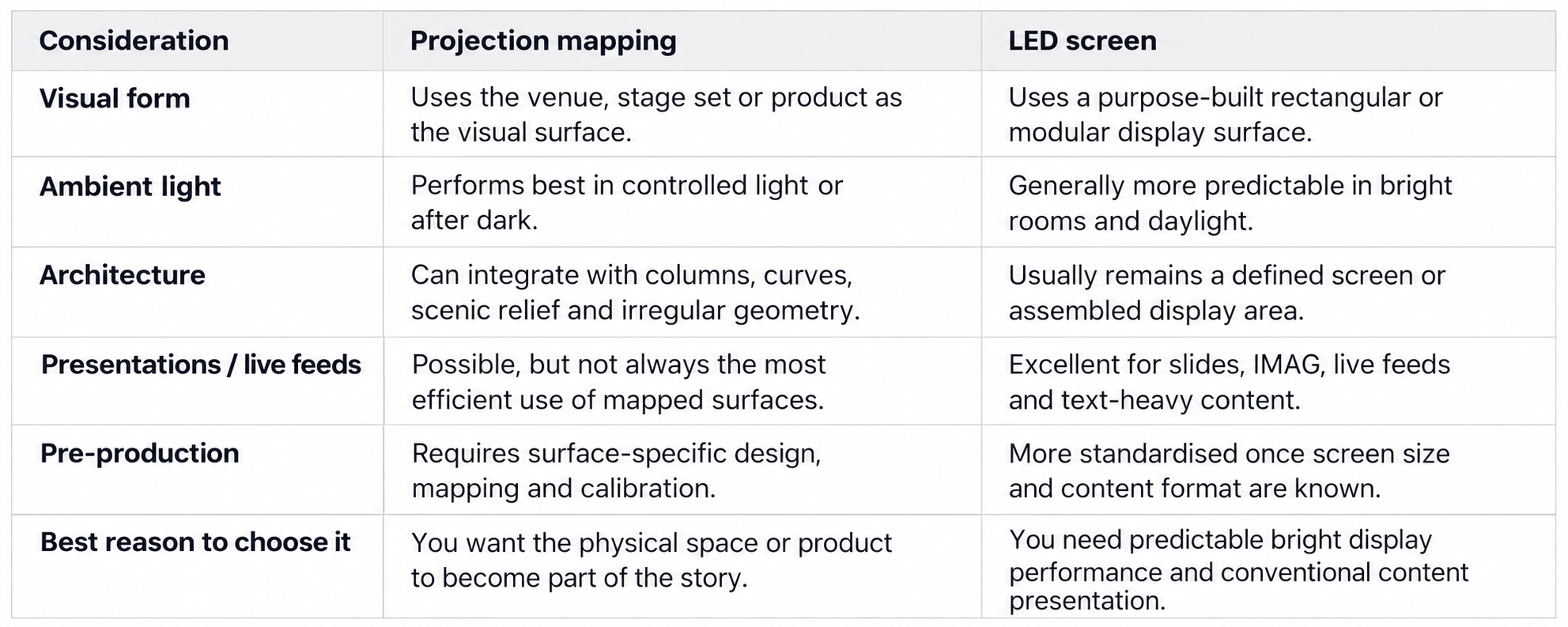
Many strong productions use both: LED for information andlive content, projection mapping for the environmental or reveal moments that need the room itself to transform.
When projection mapping is the right choice and when it is not
Projection mapping is usually a strong fit when the venue has a surface worth transforming, the event has a clear hero moment or narrative, lighting can be controlled, the audience has good sightlines, andthe team has enough time to create content for the space.
It may be the wrong tool when the event happens in bright uncontrolled daylight, there is no viable projector position, the main need is text-heavy presentation content, the surface is highly reflective or unsuitable, or the schedule leaves no time for proper design and rehearsal.
In those situations, an LED system, conventional scenic build, AR experience or another technology may produce a better result. The medium should serve the message not the other way around.
What determines whether event projection mapping actually looks good?
· The brief. What should theaudience understand, feel or remember?
· The surface. Geometry,colour, texture and reflectivity determine how the projection behaves.
· Ambient light. Projectionis light competing with other light; uncontrolled lighting can flatten even excellent content.
· Projector positions and sightlines. A beautiful design fails if the projector cannot cover the surfaceor part of the audience cannot see the effect correctly.
· Content created for the surface. Generic video on a mapped wall is still generic video. The strongest effects are anchored to real geometry.
· Sound and show timing. Areveal lands when music, lighting, projection and live cues reach the same moment together.
· Technical rehearsal. The final calibration has to happen in the real venue under the lighting conditions the event will actually use.
How Hoola approaches projection mapping for events
1. Start with the audience moment
We begin with what the event needs to achieve: launch,explain, reveal, celebrate, impress, involve or change perception.
2. Read the venue and product
We assess the surfaces, dimensions, audience positions,light, projector locations, power, rigging and practical constraints before locking the creative treatment.
3. Design the experience
The story, visual direction, mapped surfaces, transitions,sound and any interactive elements are shaped as one audience journey.
4. Build the content for the geometry
The content is created around the actual stage, object or architectural surface rather than forced into it afterwards.
5. Engineer the technical system
Projectors, lenses, media servers, playback, power, audioand control are specified around the real environment and show requirements.
6. Previsualise, review and rehearse
The client sees the concept before show day; the final system is then calibrated and rehearsed in the venue.
7. Operate and capture
The show is run live, and the key moments are captured sothe experience can continue through event films, social content and future campaign use.
What to send Hoola in the first brief
A useful first brief does not need to be long. Send:
· Event date, city and venue.
· Event type and the main audience.
· The single moment or message the experience needs to deliver.
· Photos, plans or dimensions of the stage, product, wall, ceiling or building you want to use.
· Approximate audience position and size.
· Event timing and whether ambient light can be controlled.
· Existing stage, lighting,sound and AV plans if available.
· Brand guidelines, product assets or campaign material.
· Desired show duration and whether it will repeat.
· Any social, filming orcontent-capture requirements.
From that information, the creative and technical direction becomes much easier to scope accurately.
How much does projection mapping for an event cost?
There is no useful one-price answer because two events inthe same ballroom can require completely different systems.
Cost is shaped by the size and geometry of the mapped surface, ambient light, number and class of projectors, lenses, content complexity, show duration, interactive or live elements, sound, rigging, media servers, setup time, rehearsals and number of event days.
A simple mapped scenic element and a full product reveal with original 3D animation are different productions. A good quotation starts with the experience you want and the environment it has to work in.
How far in advance should projection mapping be planned?
Bring the projection team in before the stage and venue design are fully locked whenever possible.
Simple treatments can sometimes be produced quickly, but original 3D content, product animation, complex scenic surfaces, multiple approval cycles or building-scale work need more time.
The earlier projection, lighting, scenic and audio decisions are coordinated, the less likely one system is to undermine another on showday.
From event moment to reusable brand content
The live experience may last minutes, but the creative asset does not have to disappear when the event ends.
Mapped animation can often be adapted into launch films,teaser edits, social clips, recap content, presentation visuals or future campaign material, subject to the way the content was designed and licensed.
Plan that reuse before production begins. A sequence designed only for a wide stage may not automatically become a strong vertical Reel; creating both outcomes intentionally produces better event and socialcontent.
Why Hoola
Hoola is an immersive visual technology company in Pakistan combining creative story telling with the technical systems required to build and operate the experience.
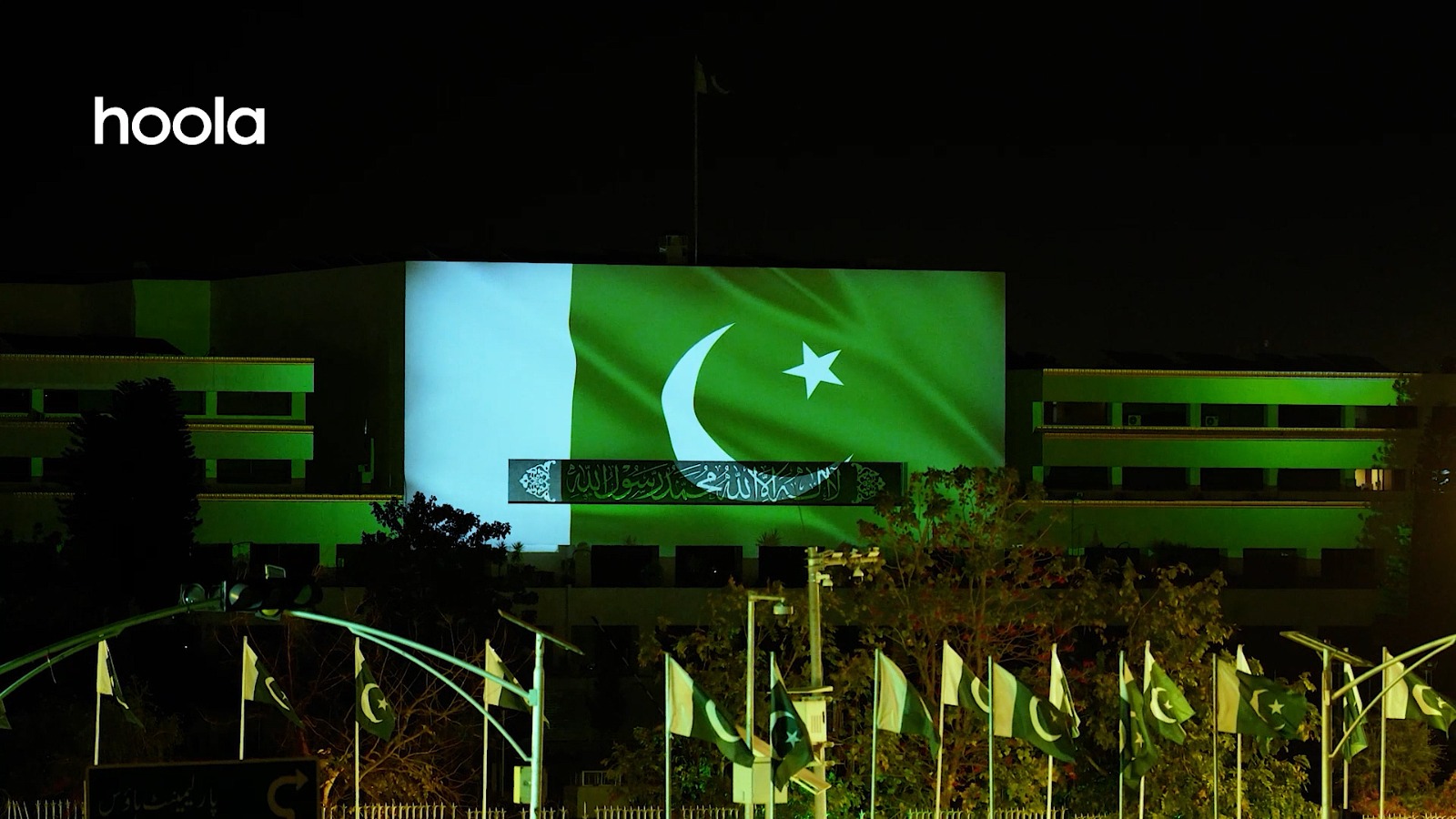
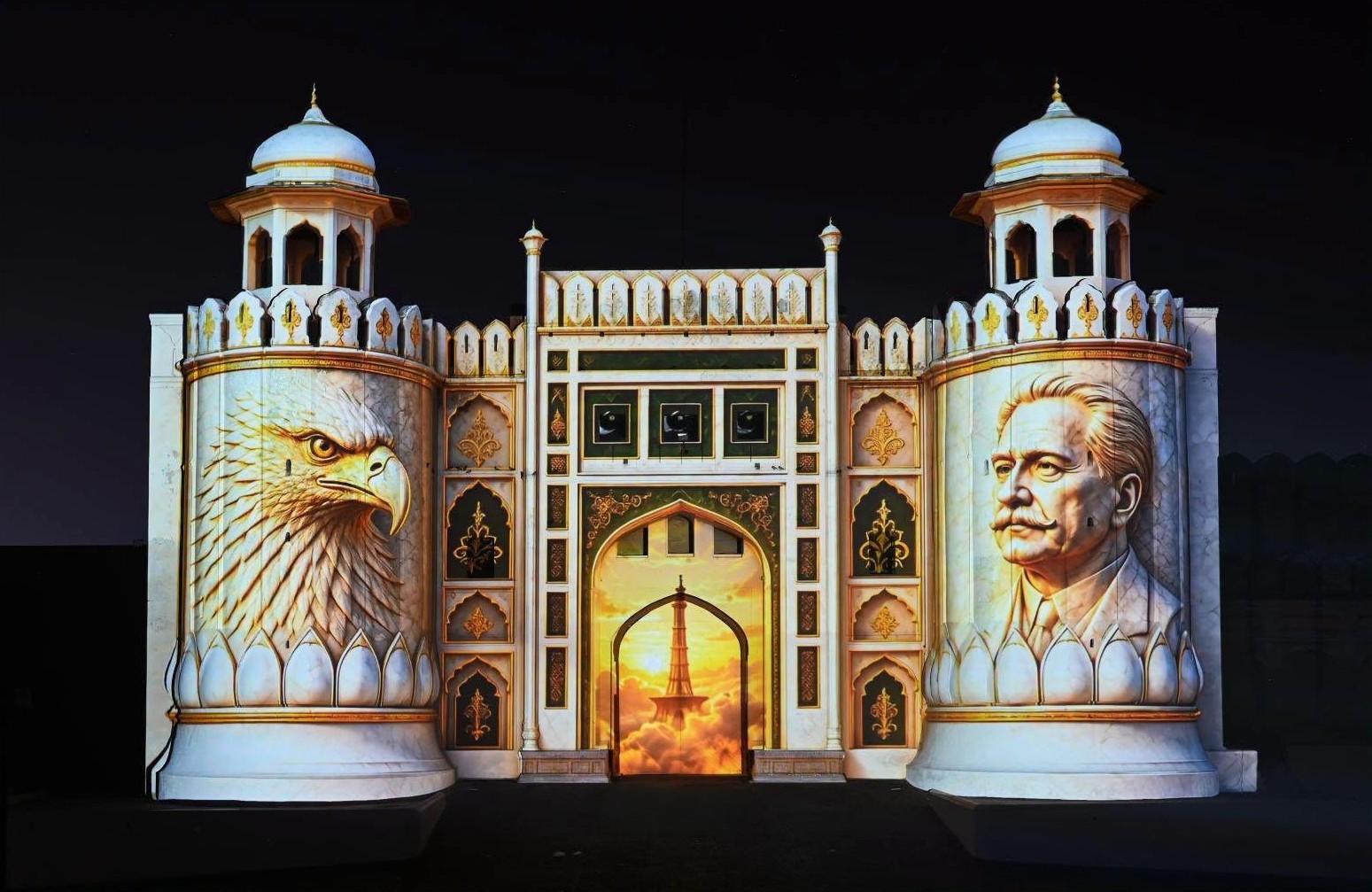
Our projection work includes landmark-scale projects at Lahore Fort, Town Hall Lahore, Army Museum Lahore, Pakistan Monument,Parliament House Islamabad, Governor House Punjab, Mazar-e-Quaid, Mohatta Palace, Darbar Mahal, Noor Mahal and other sites across Pakistan.
Those projects require the same disciplines that matter in acorporate environment: understanding the surface, building content for real geometry, controlling light, engineering projection systems, synchronising media and delivering on a date that cannot move.
For a corporate launch or brand activation, the scale may change. The discipline does not.
Planning a launch, conference or brand experience?
Tell us the date, venue, audience and the moment you want people to remember.
Hoola can help determine whether projection mapping is theright medium and if it is, design the creative and technical system around the experience rather than adding it at the end.

Ideas From the Future ofImmersive Tech
Projection Mapping for Corporate Events: 5 Reasons It Works

Planning a projection show?