How Hoola Delivered Five Landmark 3D Projection Mapping Experiences Across Pakistan.
How Hoola Delivered Five Landmark 3D Projection Mapping Experiences Across Pakistan
Five iconic landmarks. Two cities. One national celebration. For Pakistan's Independence Day 2026, Hoola delivered five site-specific projection mapping experiences across Lahore and Islamabad in parallel. One landmark projection is already a multi disciplinary production.
The architecture has to be surveyed and digitally mapped. Content has to be designed around that specific geometry. Projection positions,sightlines, brightness, playback systems, technical infra structure and public viewing areas all have to work together.
Then everything has to perform on the real building, infront of a live audience, around a national date that does not move.
For Pakistan's Independence Day celebrations in August 2026, Hoola did this across five major landmarks in parallel.
Three were in Lahore. Two were in Islamabad.
Each site had different architecture, different technical conditions, different audiences and different institutional stakeholders.
The challenge was not simply producing five shows. It was delivering five site-specific immersive experiences as one national-scale operation.
Five landmarks across Lahore and Islamabad
The Independence Day programme included:
· Lahore Fort Alamgiri Gate
· Town Hall Lahore
· Army Museum Lahore
· Parliament House Islamabad
· Pakistan Monument Islamabad
No two presented the same canvas.
At Lahore Fort, the monumental architecture of Alamgiri Gate brought depth, towers, arches and historic geometry into the projection.
Town Hall Lahore presented an entirely different civic façade, defined by its own windows, arches and architectural rhythm.
Army Museum Lahore required an experience suited to asetting already associated with history, national memory and immersive story telling.
In Islamabad, the broad monumental form of Parliament House demanded visual compositions capable of carrying across a very different scale.
Pakistan Monument was different again: a sculptural national landmark whose petal-like forms curve and change orientation rather than behaving like a conventional flat façade.
Why five projects in parallel are different
Five projects delivered one after another can share resources.
A technical crew can complete one site and move to the next. Equipment can be redeployed. Lessons from one installation can immediately inform another. Parallel delivery removes that advantage.
Every landmark needs to be operational at the same time.That means independent projection systems, playback environments, technical crews, calibration, on-ground support and contingency planning across multiplesites.
And Independence Day introduces one condition that cannot benegotiated: the date does not move.
A technical issue in Lahore cannot be solved by delaying Islamabad. A site waiting for final calibration cannot borrow another location's show window.
Each problem has to be solved where it occurs while the rest of the operation continues towards the same national moment.
That requires more than creative capability. It requires operational depth.
Five buildings require five site-specific projection builds
One of the most common mis conceptions about projection mapping is that a video can simply be created once and projected onto different buildings. True architectural projection mapping does not work that way.
The content is designed around the physical geometry of a particular structure. Windows, towers, arches, columns, edges and recesses become part of the animation. A sequence designed around Alamgiri Gate cannot simply be transferred to Town Hall. Content mapped for Parliament House cannot simply be projected onto the sculptural form of Pakistan Monument.
Each landmark therefore required its own site-specific architectural mapping and visual build. What could remain consistent was the larger creative language of Independence Day. The architecture changed. The compositions changed. The technical conditions changed. But each experience still had to feel part of the same national celebration.
3D projection mapping in Lahore
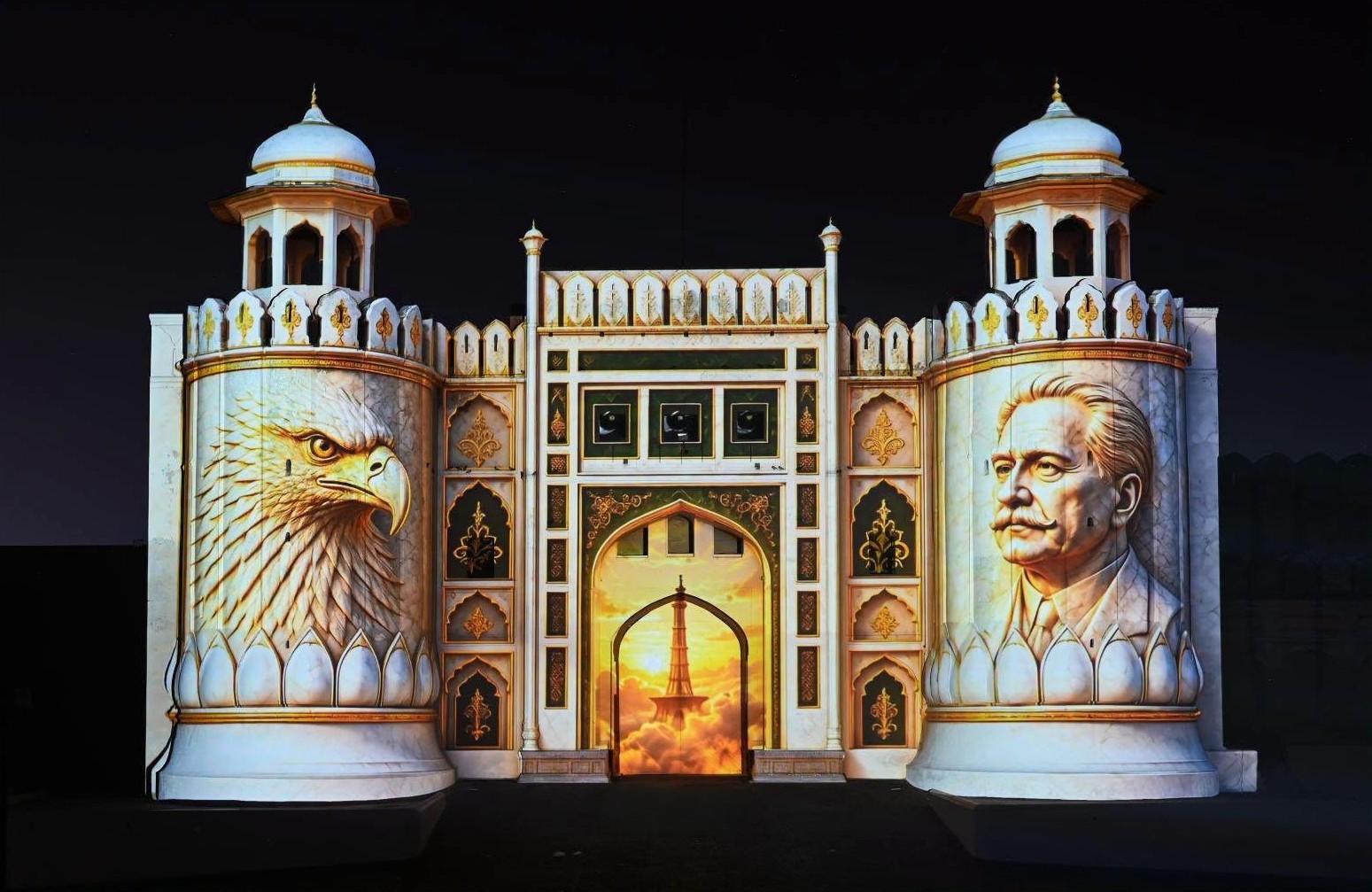
Lahore Fort Alamgiri Gate
At Lahore Fort, Alamgiri Gate became the canvas for The Promise of Pakistan, a large-scale 3D Light & Sound experience created for Independence Day.
The architecture was not treated as a flat screen. Its towers, arches, openings and structural depth became part of the visual composition, allowing the historic gateway it self to appear to transform as the experience unfolded.
The show was open to the public and drew large crowds during the Independence Day celebrations.
For Hoola, the project demonstrated how immersive visual technology can bring contemporary story telling to one of Pakistan's most recognisable historic landmarks without permanently altering the architecture.
Town Hall Lahore
At Town Hall Lahore, Hoola created a continuously running projection experience designed for a changing public audience throughout the night.
The public response was substantial. Crowds continued to build around the site, eventually requiring special crowd management arrangements by the authorities.
For many people attending, it was their first encounter with large-scale 3D projection mapping on such a familiar Lahore civic landmark.
For a few hours, a building embedded in the everyday life ofthe city became a destination in itself.
Army Museum Lahore
At Army Museum Lahore, the Independence Day activation formed part of Hoola's broader work in immersive historical story telling.
Large-scale visuals, projection and sound were used in a setting already closely connected with Pakistan's national and military history.
The public programme attracted significant attendance, placing Army Museum along side Lahore Fort and Town Hall as part of a wider city-scale Independence Day experience.
Projection mapping in Islamabad
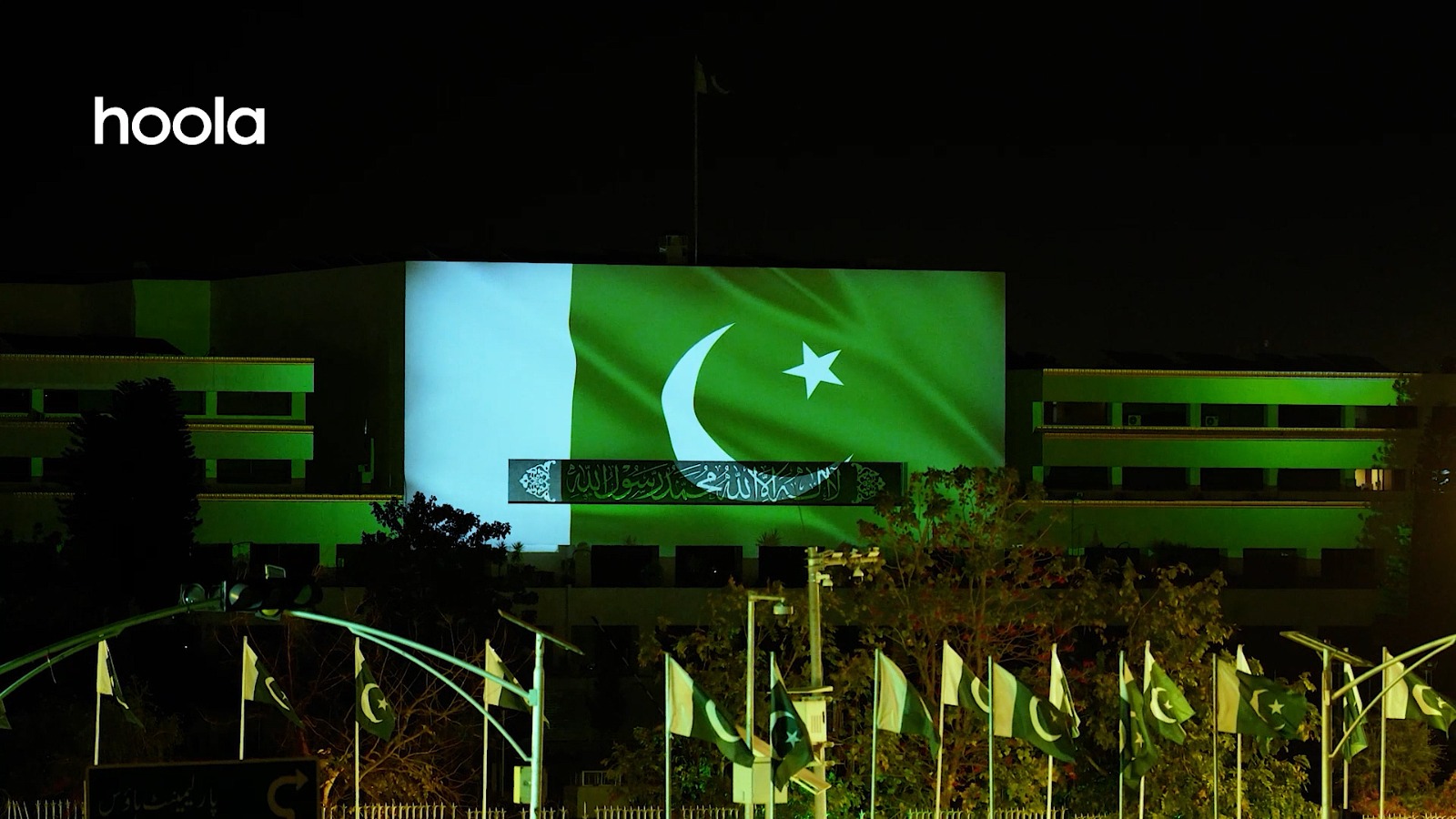
Parliament House Islamabad
At Parliament House Islamabad, Hoola worked on a completely different architectural scale.
Where Lahore Fort offers intricate historical detail, Parliament House presents broad geometry and monumental surfaces.
That changes the creative problem. A composition has toremain visually powerful across a much larger façade while still working withthe architecture rather than simply covering it with imagery.
The Independence Day installation, commissioned through CDA, transformed one of Pakistan's most recognisable institutional buildings intopart of the national celebration.
Pakistan Monument Islamabad
Pakistan Monument required another approach altogether.
Its sculptural, petal-like form creates projection surfaces that curve, separate and change orientation. Content has to be designed around that geometry rather than imposed upon it.
For a landmark conceived as a symbol of the federation, its transformation for Independence Day carried particular significance.
Through projection mapping, the monument became part of the visual celebration rather than merely its back drop.
Two cities had to operate independently
Once the programme went live, Lahore and Islamabad could notfunction as one physical production environment. Equipment could not simply be moved between the two cities.A technical specialist dealing with an issue at Lahore Fort could not simultaneously solve one at Pakistan Monument.
Each city and ultimately each site needed sufficient technical capability to operate independently.
That meant planning for equipment, crews, playback, calibration and contingency at a multi-site level.
This is where large-scale projection mapping becomes as much an operational discipline as a creative one.
The complexity happens behind the scenes. The audience should only see the result: a landmark transforming in front of them.
Built for a public audience
A defining feature of the Independence Day programme was itspublic character.
At Lahore Fort, Town Hall Lahore and Army Museum Lahore, large audiences came to experience the activations in person.
Families gathered. People stopped on their way through thecity. Audiences filmed the transformations and shared them online. At some locations, visitors stayed for repeated runs.
The Islamabad landmark installations were also widely appreciated, while imagery and video from the wider programme extended the audience far beyond the people physically standing in front of the buildings.
That is one of the particular strengths of landmark projection mapping.
The physical experience may exist at one location. Its cultural and digital reach can extend much further.
Transforming architecture without permanently changing it
Projection mapping is particularly suited to historic, civicand culturally significant architecture because the transformation itself is temporary. Digital content is precisely aligned with the building while projection equipment and technical infra structure remain separate from the façade.
That allows architecture to appear to move, open, transformor reveal entirely new environments without requiring permanent visual alteration to the structure. For heritage architecture such as Lahore Fort and major national buildings such as Parliament House that quality matters.
The experience can feel monumental. The intervention doesnot need to be permanent.
What five simultaneous landmark projects actually demonstrate
The most visible part of projection mapping is the image onthe building. Delivering five landmark experiences in parallel demonstrates capabilities that are harder to photograph.
· site-specific architectural mapping
· simultaneous creative production
· multiple independent projection systems
· media-server and play back infrastructure
· technical teams operating a cross several locations
· logistics across two cities
· coordination with different institutions and authorities
· public-space operations
· contingency planning
· the operational discipline to bring all of those elements together around the same national occasion
That combination is what large-scale immersive execution actually means.
Hoola was not simply supplying visual content to five buildings.
It was running five independent landmark productions under one creative and operational direction.
More than a projection company
For organisations planning a landmark activation, national programme, public event, product launch or large-scale immersive experience,the distinction matters. The creative idea is only one part of the project. Someone still has to translate that idea onto real architecture. Someone has to design the technical system. Someone has to get equipment and crews into place. Someone has to map and calibrate the building. Someone has to run the show.
And when several sites have to go live together, someone has to make the entire operation work as one. For Hoola, Independence Day 2026 demonstrated that these capabilities can exist under the same roof: creative production, immersive visual technology, 3D projection mapping, technical infrastructure and on-ground execution at scale.
Five landmarks. Two cities. One national moment.
For Pakistan's Independence Day 2026, five very different pieces of architecture became part of the same celebration.
- Lahore Fort.
- Town Hall Lahore.
- Army Museum Lahore.
- Parliament House Islamabad.
- Pakistan Monument Islamabad.
Historic architecture. Civic architecture. Military heritage. National symbols.
Each transformed in its own way. Together, they became onenational-scale immersive programme.
Five landmarks. Two cities. One national moment. Brought to light by Hoola.


Ideas From the Future ofImmersive Tech
Projection Mapping for Corporate Events: 5 Reasons It Works

Planning a projection show?