Town Hall Lahore Transformed Through 3D Projection Mapping.
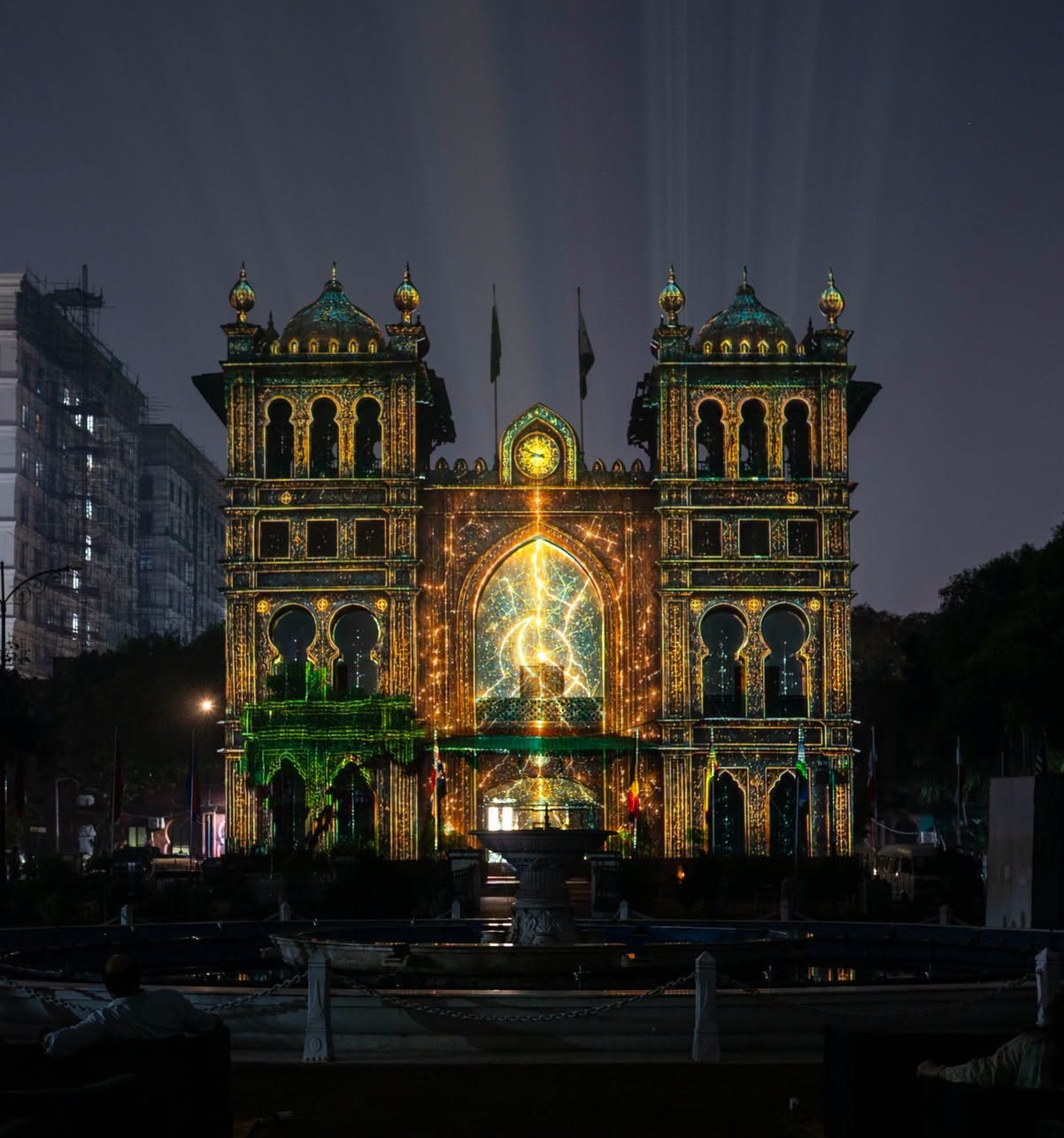
Town Hall Lahore Transformed Through 3D Projection Mapping
On Independence Day, Town Hall became a six-hour projection spectacle that drew crowds across central Lahore. Weeks later, Hoola returned with a full 3D
Light & Sound Show combining projection mapping, sound, and poetry to tell a story of sacrifice, resilience, and hope.
Same landmark. Two national occasions. Two entirely different experiences. In August and September 2026, Hoola transformed Town Hall Lahore twice
through large-scale 3D projection mapping first for Pakistan's Independence Day celebrations on 14 August, and again for Defence Day on 6 September.
The first activation was designed as a continuously looping public spectacle: celebratory, immediate, and accessible to people arriving throughout the night.
The second was a complete Light & Sound Show with a beginning, progression, and conclusion, using projection, sound, and poetry to move audiences
through history, sacrifice, resilience, and hope.
Together, the two projects showed how the same architecture can carry completely different stories when the building itself becomes the canvas.
14 August: A Familiar Landmark Becomes a Spectacle
On 14 August 2026, Town Hall Lahore was transformed through large-scale architectural projection mapping as part of the city's Independence Day
celebrations. The experience ran continuously from 8 PM until 2 AM. Rather than a conventional performance with a fixed beginning and end, the content was
designed as a loop so people arriving at any point during the six-hour window could encounter the transformation, stay for a complete sequence, and watch it
again.
For many people in attendance, it was their first encounter with architectural projection mapping at this scale on such a familiar Lahore landmark. The
response was immediate. Crowds continued to build around Town Hall as the evening progressed. People stopped, filmed, shared, and stayed for repeated
runs. The turnout became large enough that government authorities made special arrangements for crowd management, with dozens of police personnel
including riot-control personnel deployed around the venue to maintain safe public movement.
In practical terms, the activation broke the ice for the public. Projection mapping stopped being an abstract technology and became something Lahoris had
experienced first-hand on a building they already knew.
For those six hours, Town Hall was no longer simply part of the streetscape. It had become the destination.
One of Five Landmark Experiences Delivered in Parallel
Town Hall was also one part of a much larger Independence Day operation.
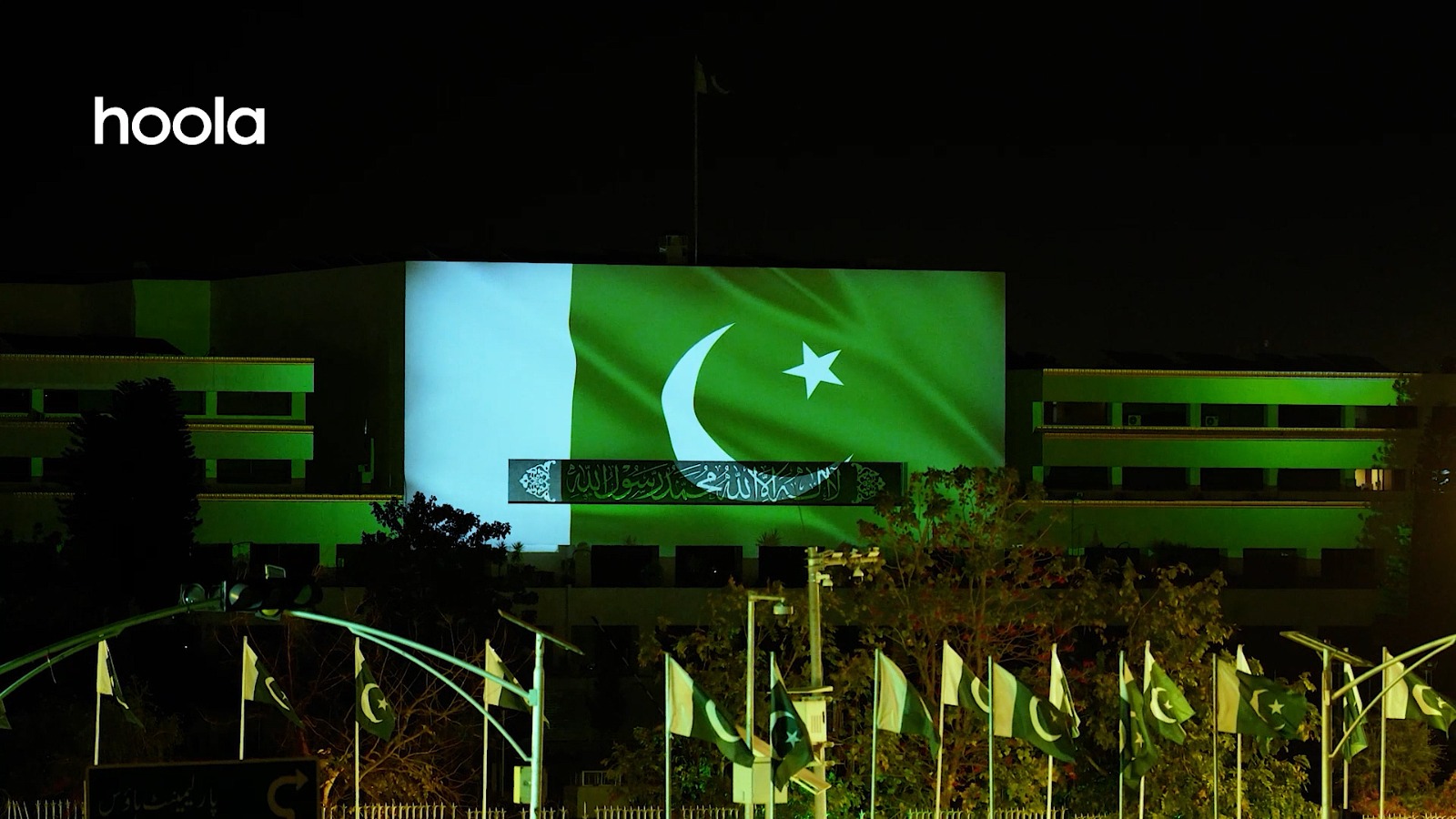
For the 14 August celebrations, Hoola delivered immersive visual experiences across five major landmarks in Lahore and Islamabad in parallel:
- Town Hall Lahore
- Lahore Fort
- Army Museum Lahore
- Parliament House Islamabad
- Pakistan Monument Islamabad
Delivering five landmark activations across two cities at the same time required creative production and technical operations to function as one system.
Projection systems, media servers, architectural mapping, content, technical crews, logistics, and on-ground operations all had to be coordinated across
multiple sites within the same national celebration.
That capability is an important part of large-scale projection mapping in Pakistan: not simply creating one impressive show, but being able to deliver
immersive experiences reliably across several high-profile locations in parallel.
6 September: From Spectacle to Storytelling
When Hoola returned to Town Hall for Defence Day, repeating the Independence Day experience was never the objective. The emotional language had to
change. Where 14 August had been celebratory and continuously accessible, the 6 September activation was designed as a full, structured 3D Light & Sound
Show a complete experience with a beginning, progression, and conclusion.
Projection mapping was combined with cinematic visuals, sound, and poetry to make the history and emotion associated with Defence Day feel immediate
rather than distant. The show moved through hardship, uncertainty, sacrifice, and perseverance. Poetry gave the visuals an emotional spine, while the
architecture of Town Hall became part of the storytelling rather than simply a surface behind it.
But the experience was deliberately not designed to end in hardship. Its final movement was towards resilience, hope, and confidence: a reminder that people
who have endured enormous challenges before can continue to find the strength to overcome them.
That transition from remembrance to resilience became the heart of the Defence Day experience.
When Architecture Becomes Part of the Story
True 3D projection mapping is not simply video projected onto a wall. The visual content is designed around the physical geometry of the building. Windows,
arches, columns, recesses, and structural details become reference points for the animation.
When the mapping is precise, those architectural elements can appear to move, open, disappear, or transform into entirely new environments. The audience
stops seeing an image on a building and begins to perceive the building itself changing. That relationship between digital content and physical architecture
allowed Town Hall to carry two very different experiences within weeks of each other.
The technology was similar. The storytelling was not.
Six Hours, Changing Audiences, and a Live Public Space
Both Town Hall activations ran from 8 PM until 2 AM, which created a very different production challenge from a single scheduled performance. People
arrived continuously. Some encountered a sequence from the beginning. Others joined halfway through. Some stayed for a complete run, while others
remained to watch again.
For the looping Independence Day installation, this meant creating a visual experience that could be entered at almost any point without losing its impact.
For the Defence Day show, it meant creating a coherent narrative while ensuring that individual sequences were strong enough to capture the attention of
people encountering the experience mid-show.
That balance between storytelling and spectacle is especially important for projection mapping in public spaces, where the audience is constantly changing.
The Public Response Mattered
Projection mapping can look impressive in a photograph or perform well in a short social-media clip. The more meaningful test is whether people stop and
give the physical experience their attention. At Town Hall, they did.
People watched complete runs. Many stayed for another. As fresh audiences continued to arrive, crowd movement had to be actively managed so that people
waiting behind could also experience the show.
That response turned a familiar civic landmark into a destination for the evening first through the novelty and scale of the Independence Day activation, and
then through the emotional depth of the Defence Day show.
Projection Mapping on an Active Civic Landmark
Working at Town Hall also meant operating in a live urban environment rather than a controlled event venue. Large-scale architectural projection requires
careful planning around projector positions, throw distances, viewing angles, image alignment, ambient light, traffic, pedestrian movement, equipment
protection, and public viewing areas.
Before the audience sees the finished experience, the façade has to be digitally mapped so the visual content aligns with the building's physical geometry.
When all of those elements work together, the technology becomes almost invisible. What remains is the illusion: a familiar piece of architecture behaving in a
way the audience has never seen before.
Two National Occasions. One Landmark. Two Completely Different Experiences.
Within a matter of weeks, Town Hall Lahore carried two distinct national experiences. On Independence Day, it became a public spectacle bright, celebratory,
and continuously unfolding. On Defence Day, it became a storyteller using 3D projection mapping, sound, and poetry to connect history with resilience and
hope. The architecture remained the same. Everything the audience experienced through it changed.
For Hoola, the two projects demonstrate what becomes possible when architecture, storytelling, immersive visual technology, and large-scale technical
execution are designed as one experience. For a few hours, a building people know can become something they have never seen before.
And when the projectors switch off, the architecture remains. The experience is what stays with the audience.


Ideas From the Future ofImmersive Tech
Projection Mapping for Corporate Events: 5 Reasons It Works

Planning a projection show?