Hoola Lights Pakistan's Landmarks for the Makkah Agreement

Hoola lights three national landmarks for the Makkah Joint Defence Agreement
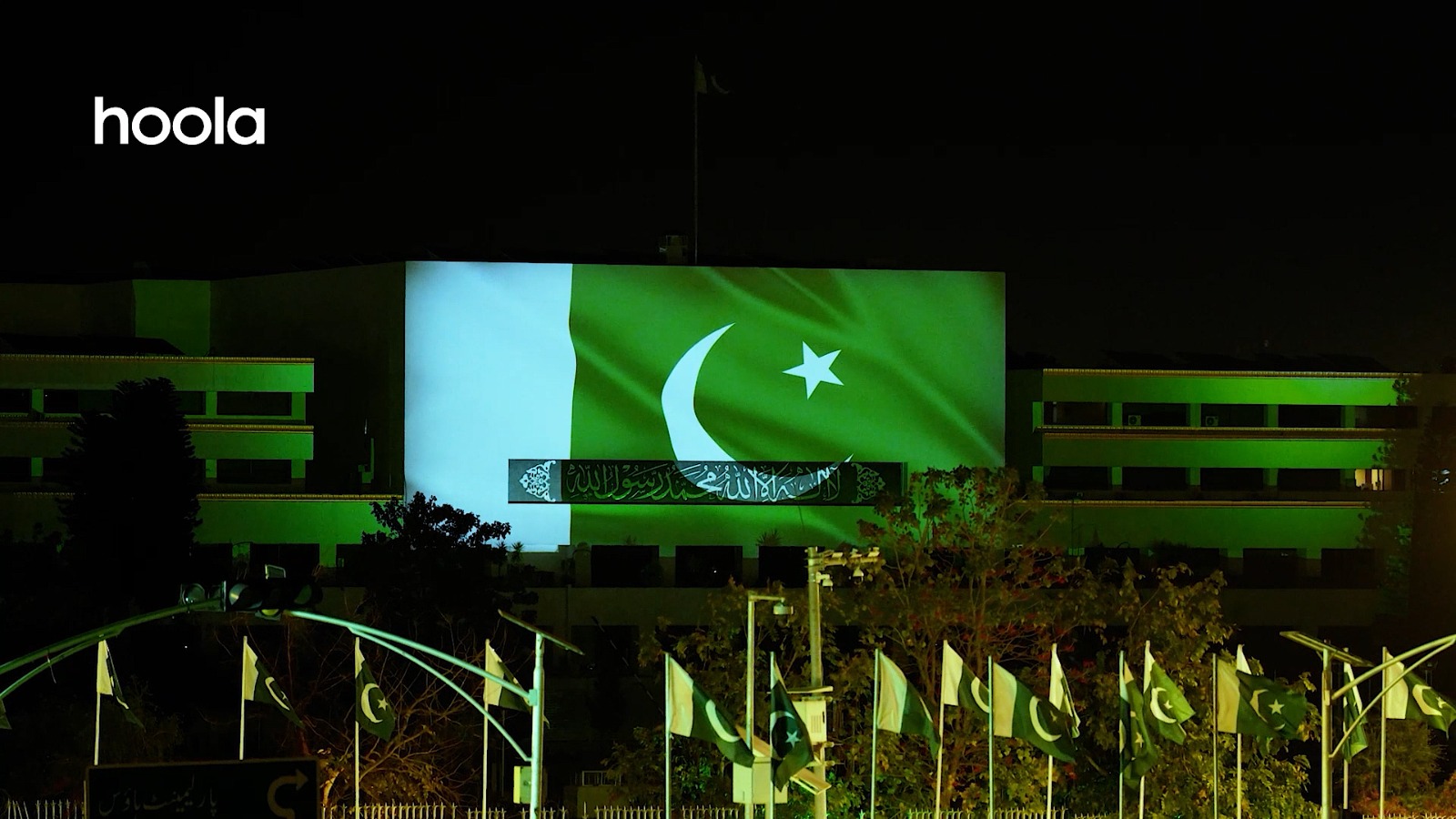
Projection mapping by Hoola at Army Museum Lahore, Parliament House and Pakistan Monument,marking a new chapter between Pakistan, Saudi Arabia and Turkey.
On 7 August2026, Pakistan, Saudi Arabia and Turkey signed the Makkah Joint Defence Agreement. It was a significant moment for the country, and in the nights that followed it was marked the way national moments are increasingly marked in Pakistan: in light, on the buildings people already know.
Hoola delivered projection mapping across three of them: Army Museum Lahore, Parliament Houseand Pakistan Monument. Three buildings, two cities, one message.
What Hoola put on the buildings
Each of the three landmarks has a different shape, a different setting, and a different place in the national story. Hoola designed a single visual language that worked across all three, carrying the flags of Pakistan, Saudi Arabia and Turkey and a shared expression of brotherhood between the three countries.
Nothing was attached to any of the buildings. In projection mapping, light is the onlything that touches the structure. The surfaces were left exactly as they were found, which is what makes the technique suitable for national and heritage architecture in the first place.
Why light, and why these buildings
A bill board tells you something. A building that changes in front of you does something different. It gathers people, it holds them for a few minutes, and it puts the message on a structure the public already associates with the country itself.
That is why projection mapping has become part of how national moments are marked, in Pakistan and else where. Landmarks in Saudi Arabia and Turkey were illuminated in the same days, in the same three flags. The medium travels well because it needs no explanation. People simply look up.
Behind the work: three landmarks, three builds
Mapping three separate landmarks is three separate projects. Each surface has its own geometry, its own viewing angles, and its own constraints on where equipment can be placed and how much light the facade will take. Content designed for one building will not sit correctly on another, so Hoola treated each site on its own terms while holding one visual language across all three.
Work of thiskind also runs to a date that cannot move. The moment either lands on the nightor it does not happen at all, which is why testing on the actual surface matters more here than in almost any other kind of production.
.webp)
Ideas From the Future ofImmersive Tech
Projection Mapping for Corporate Events: 5 Reasons It Works

Planning a projection show?


.webp)